

Welcome to the April edition of the Educate Against Hate newsletter. This month’s newsletter includes:
- Updates to the Educate Against Hate website
- Resources and activities to mark Stephen Lawrence Day
- New research published and a guide for tackling conspiracy theories
- Embedding Fundamental British Values – a whole school approach
- National day for victims and survivors of terrorism
We know that teachers and school leaders face constant pressure on their time. When you are juggling safeguarding responsibilities, curriculum planning and the day-to-day demands of school life, finding reliable guidance or classroom resources quickly isn’t just helpful – it’s essential. That’s why Educate Against Hate has recently introduced a series of improvements to the site’s content design, navigation and search features to help you get exactly what you need, faster.
The Educate Against Hate team interviewed teachers and leaders in schools and colleges across the country who regularly use EAH, to find out what changes we could make to the website to ensure the user experience better meets their needs.
The updated resource library now includes clearer categorisation, improved tagging and more intuitive filtering. Whether you’re looking for practical classroom materials, whole school approaches or guidance on responding to specific risks, you can now navigate directly to what matters most with fewer clicks.
We’ve organised the resources into key stages so you can go straight to age-appropriate teaching materials and guidance. We’ve streamlined page layouts and updated design elements to ensure the look and feel of the website gives users the confidence that these are government approved materials that can be used with confidence.
These updates are part of our ongoing commitment to supporting schools with accessible, trustworthy resources that support our users in their vital efforts to protect young people from extremism and radicalisation. We will continue to refine and enhance the site based on your feedback, ensuring that Educate Against Hate remains a practical, time‑saving tool for teachers and leaders.
If you haven’t explored the new improvements yet, now is a great time to take a look.
This work is ongoing and we will be updating the website further, if you’d like to help us shape these improvements, please follow the link below to take part in our user research.
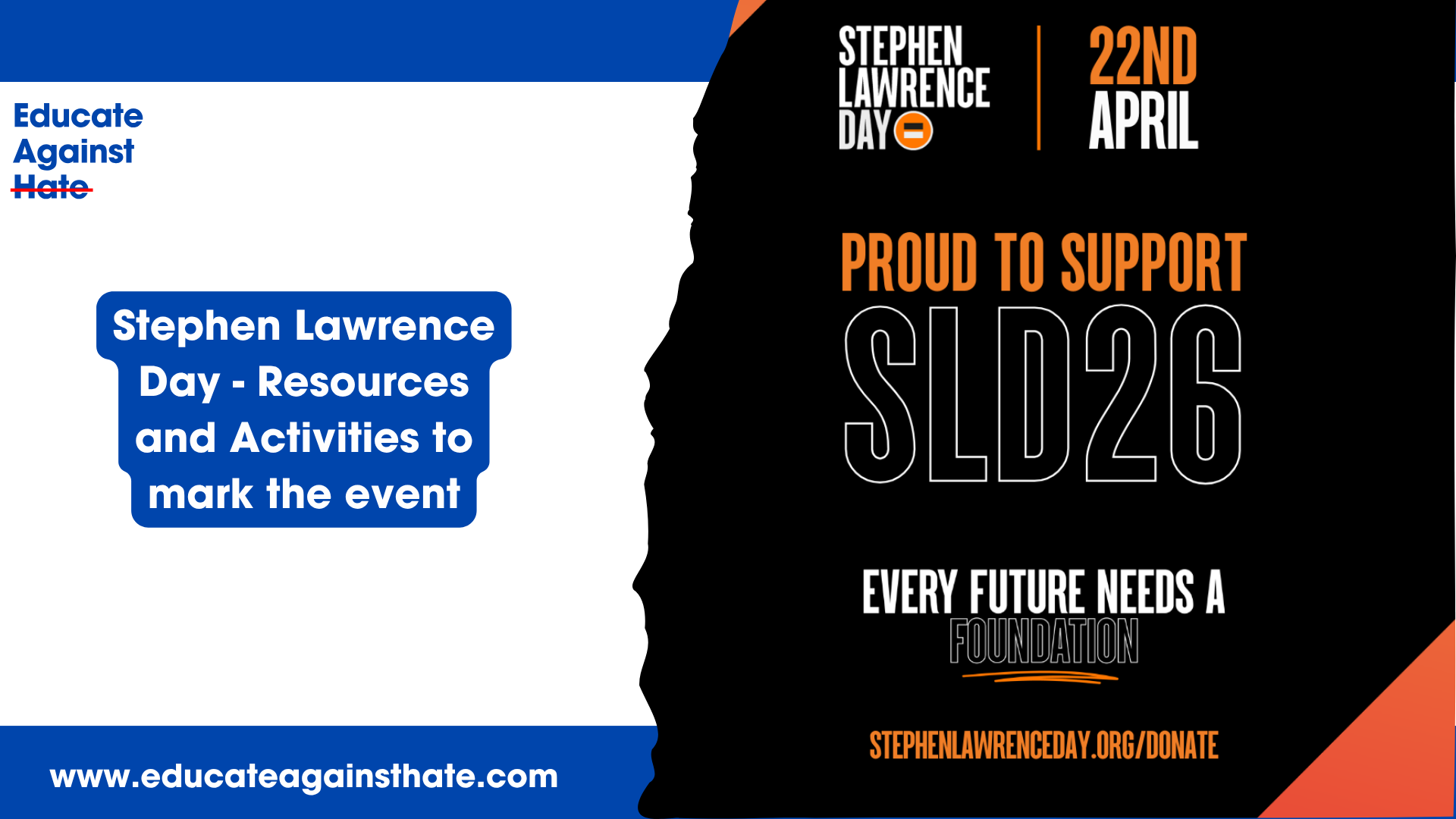
Stephen Lawrence Day takes place this year on Wednesday 22nd April. Schools can mark the day using the below resources, activities and ideas from the Stephen Lawrence Day Foundation, including:
- Holding an assembly or classroom discussion using their classroom resources.
- Hosting a “Wear Orange” day on 22 April to show solidarity
- Organising a sponsored walk, run or Challenge 22 activity
- Creating a safe space for discussion around fairness, equality and inclusion
- Sharing pupil work or reflections with your wider school community
Schools can also join the Stephen Lawrence Day Foundation’s ambassador schools, being part of a network which embeds equity and anti-racism in everyday school life. If you’re interested, contact: info@stephenlawrenceday.org

The Commission into Countering Online Conspiracies in Schools published its 2026 research insights, building off its launch report in 2025.
This new report, funded by the Pears Foundation and delivered by Public First, offers 10 new findings based on nationally representative polling with parents, pupils and teachers and focus groups with pupils, teachers and youth workers. In summary, parents felt unprepared, teachers felt unequipped and young people felt overwhelmed.
Some of the key findings include:
However, school staff are trusted by parent to tackle online conspiracy belief, misinformation and disinformation with 75% of parents trusting teachers in this area.
Concern is growing – parental reports of their child raising a conspiracy belief have risen by a third since 2025 and there has been a corresponding 35% jump in the number of young people saying fake news and disinformation and are a problem in their school.
71% of young people, 78% parents and 85% of school staff said it was getting harder to tell what was real or fake online.
36% of all school staff have not had any training on tackling online conspiracies, our polling suggests. This rises to 50% for primary school staff.
You can find the full report here
Don’t forget the support already available on EAH that can help teachers to tackle online conspiracies:
- Online Misinformation and the UK Riots – Educate Against Hate
- Online Media Literacy Resources – Educate Against Hate
- Support Your Learners to Stay SAFE Online – Educate Against Hate
The National Institute of Teaching’s Centre for Digital Information Literacy in Schools (CDILS), supported by the Pears Foundation, has released a guide to help schools respond to the growing challenge of conspiracy beliefs and misinformation.
Drawing on global research and insights from leading experts, the guide offers evidence‑informed messages to spark discussion and strengthen staff confidence in tackling misinformation with pupils.
The guide outlines eight key ideas:
- Young people are vulnerable to real-world harms of conspiracy theories and misinformation; the ‘information age’ amplifies this vulnerability.
- Whether people believe conspiracies and misinformation isn’t the only thing that matters.
- Conspiracy theories and misinformation appeal to people’s core psychological needs.
- Everyday mental shortcuts and biases shape what we think is true.
- We are better at catching misinformation when we can think slowly and carefully.
- To challenge misinformation effectively, you don’t have to be an expert.
- Listening and asking curious questions might be more powerful than offering answers.
- People can develop the skills to be more critical consumers of information (but there’s no magic bullet).
The guide shared is the first of what will be many CDILS resources for schools and teacher education providers. Additional activities and updates are planned, with a pilot scheduled across multiple locations for the summer.
In the meantime:
Contact CDILS to learn more – CDILS@niot.org.uk.
Read the resource and reflect on it
Share it with teachers and leaders in your networks
Navigating conspiracies and misinformation in schools

Evidence tells us that reducing the risk of radicalisation in children and young people requires a whole education setting approach to be effective.
We spoke to school leaders at Smestow Academy about their whole school approach to building resilience to extremism and embedding Fundamental British Values. Read the latest EAH blog to find out how their school’s strategic approach to this essential work and the recognition this was given in their latest Ofsted inspection.

In November 2025, the government announced that 21st August 2026 will be a new national day to remember the victims and survivors of terrorism. The inaugural event will focus on supporting those affected by terrorism, sharing their stories and recognising the impact on their lives. The date aligns with the UN International Day of Remembrance and Tribute to the Victims of Terrorism.
Educate Against Hate will be recognising and supporting this national event, with further information on plans for the inaugural day. Join us to show that terrorism and hate can never win and that we are stronger together.