


Welcome to the September edition of the Educate Against Hate newsletter. This month’s newsletter includes:
- New Educate Against Hate film series supporting teachers with difficult discussions
- An opportunity to join the Tackling Antisemitism in Education Scholarship Programme
- Support for schools and colleges implementing Martyn’s Law
- Updated Notice, Check, Share guidance
- Communicating Consequences – youth campaign
- Peerscroller – access a free trial
- Testy your knowledge with the LGfL Prevent quiz

Brave Conversations – Film series launch
Educate Against Hate (EAH) has launched a new Brave Conversations film series, designed to help educators feel more confident when discussing sensitive and challenging issues with young people.
The series brings together insights from a range of education practitioners, alongside the perspective of a student, to explore both the theory and practice behind effective difficult conversations. Through honest discussion and real-world experience, the films highlight why these conversations matter in schools and colleges, and how staff can approach them with confidence, empathy and clarity.
Covering key principles, practical strategies and common challenges, the resources are intended to support educators in creating safe and constructive spaces for dialogue with young people on complex topics. The flexible format allows staff to watch the full film for a comprehensive overview or access a selection of standalone clips, each lasting three to five minutes, focused on specific topics.
The Brave Conversations series offers a valuable professional development resource for all education staff, which can be used alongside our Building Resilience training suite.

Tackling Antisemitism in Education
The Tackling Antisemitism in Education (TAE) Scholarship Programme is funded by the Department for Education. Its purpose is to help teachers and staff in schools, colleges and universities recognise, understand, and respond appropriately to antisemitism.
It launches in November as a free, online, CPD-accredited course of about two hours with optional additional content.
The programme is open to anyone who works at a school or college in England including Designated Safeguarding Leads, PSHE and Personal Development Leads, Assistant and Deputy Heads with responsibility for inclusion, behaviour or wellbeing and Vice Principals and Principals in colleges and sixth forms.

Notice, Check, Share – updated guidance
The refreshed Notice, Check, Share (NCS) guidance has now been published. It has been developed and extensively tested over the past 12 months with frontline professionals, Prevent practitioners, CTPHQ, and other Government departments. The Prevent duty training has also been updated to reflect the new guidance, and NCS will underpin further developments to renew the training package over the coming months. The new guidance reflects recommendations from a Home Office review of Prevent thresholds, as well as wider findings from the Southport Inquiry and Lord Anderson’s review – ‘Lessons for Prevent’.
NCS reaffirms the Key Principles of Prevent, making clear that Prevent’s core purpose is to stop people from becoming involved in, or supporting, terrorism. This should be the primary consideration for anyone deciding whether to make a Prevent referral.
The refreshed guidance also provides clearer direction on what to do if you are concerned that an individual may be becoming radicalised into terrorism. This is not a change in policy but a further clarification on the steps that should be followed when identifying and referring radicalisation concerns, particularly during the ‘check’ stage.
The guidance also reiterates long-standing Prevent policy that ideology remains an important consideration, but it is not a mandatory requirement for Prevent referrals.
Where a referral is assessed as not being suitable for Prevent support, practitioners should consider whether alternative local support services may be more appropriate. The Southport Inquiry is also examining the adequacy of local arrangements for managing the risk from individuals fascinated with extreme violence, where ideology is not the primary driver. In support of this work, the Home Secretary has established a cross-Government Taskforce to address the broader approach to non-ideological extreme violence risks. The Taskforce is currently progressing interim guidance to help practitioners manage these risks, whilst longer term options are developed.

Martyn’s Law: resources and webinars for education settings
To support education settings in preparing for Martyn’s Law, the Department for Education have developed a suite of resources for the sector.
The resource pack includes:
- Martyn’s Law toolkit
- Martyn’s Law Factsheet
- Martyn’s Law Poster
- Protective security and preparedness flyer
These materials sit alongside the latest Home Office and ProtectUK resources, including guidance on notification requirements and the Home Office statutory guidance. Together they provide information to help settings understand the legislation and prepare for implementation.
Further guidance for education settings from the Department for Education will be published in due course.
To receive the latest updates about Martyn’s Law from the Security Industry Authority (SIA) and to take part in future engagement opportunities, register for the SIA Martyn’s Law newsletter.
The Home Office is hosting a series of webinars on the Terrorism (Protection of Premises) Act 2025, covering its scope, key requirements and a Q&A session. These webinars are not education specific.
Attendees only need to attend one session.
Webinar 1: 14 September
- Time: 14:00 – 15:00
- Joining link
- Meeting ID: 364 265 772 373 723
- Passcode: nk9Rj3ua
Webinar 2: 24 September
- Time: 15:00 – 16:00
- Joining link
- Meeting ID: 342 290 239 063 327
- Passcode: GB3S8z3H
Communicating Consequences – youth campaign reaches young people nationwide
Following the success of our first national youth campaign earlier this year, Counter Terrorism Policing (CTP) returned this summer with a second phase helping young people understand the potentially life-changing consequences of engaging with terrorist content online.
The campaign responds to a year-on-year rise in young people, particularly teenage boys, appearing in CTP arrest and Prevent referral figures, alongside continued exposure to harmful and extremist material online.
Our first campaign, aimed at 13–17-year-olds, showed the value of speaking directly to young people on platforms relevant to them. It delivered nearly 18 million impressions, 3.4 million video views, achieved a 65% YouTube video completion rate (40% for skippable ads is the industry standard), generated around 70,000 TikTok likes and drove almost 100,000 new users to the campaign website.
Building on this success, the summer campaign focused on 13–17-year-olds across TikTok, YouTube and Snapchat which was new for this iteration. Research with young people found the consequences that resonated most strongly with them, included losing access to their phone, passport and future opportunities.
Teachers and safeguarding professionals play a vital role in helping young people navigate online harms and recognise concerning behaviour.
For further information and advice, visit the campaigns website, “What You Share Leaves a Trace.”
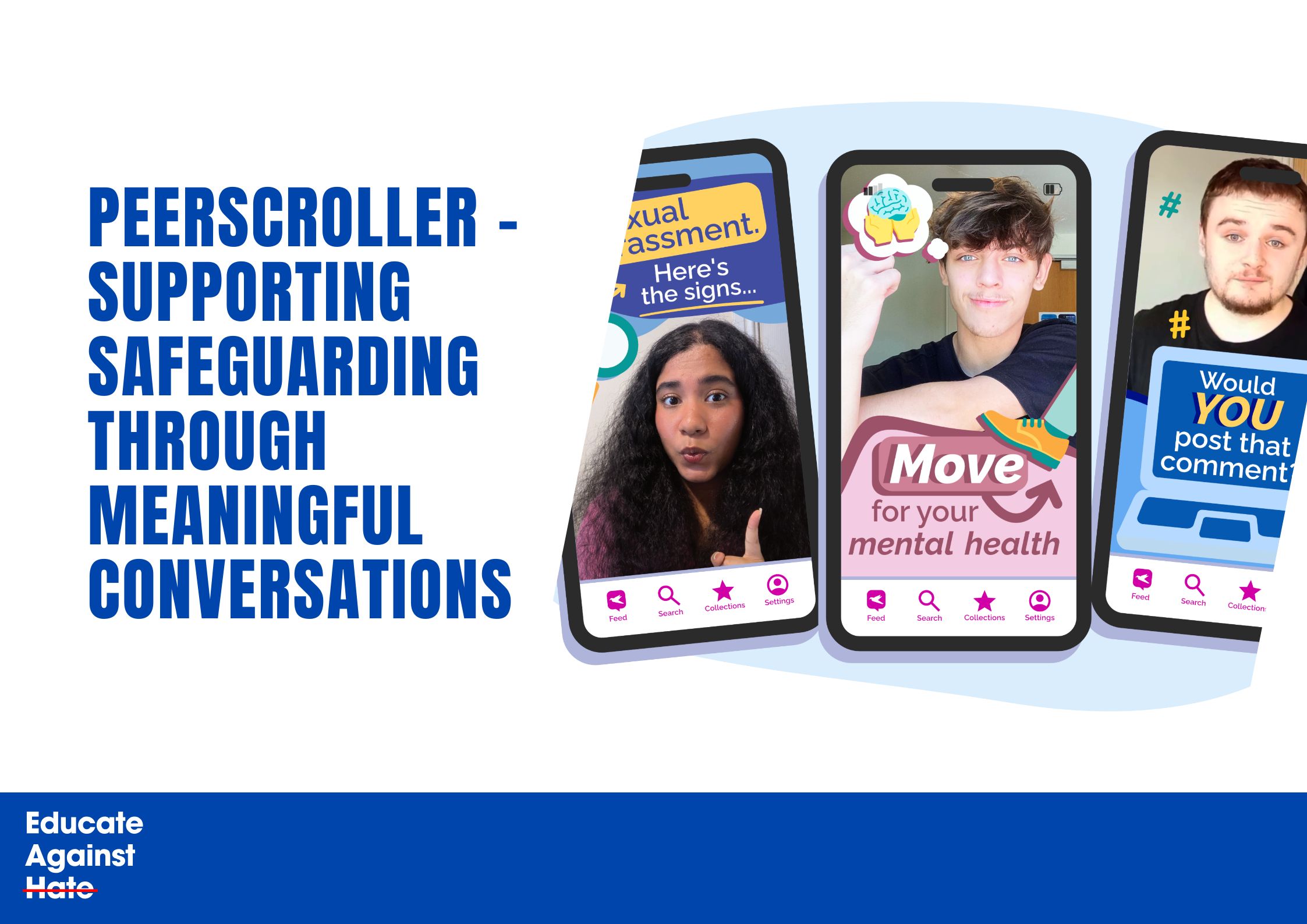
Peerscroller supporting safeguarding through meaningful conversations
Charlton School has been using Peerscroller videos to support conversations arising from concerns identified through its CPOMS safeguarding processes, with promising results.
The school’s Designated Safeguarding Lead selected short-form videos tailored to individual pupils’ needs and used them during one-to-one meetings as discussion starters. The familiar social-media style format helped pupils engage quickly and reflect on issues affecting their wellbeing, behaviour and decision-making.
For one Year 7 pupil, a video about role models prompted reflection on the impact of his behaviour on others and led him to identify a personal goal to reduce classroom disruption. Another student connected with content exploring emotional regulation. Follow-up discussions helped reinforce positive influences and decision-making.
Importantly, the videos also supported engagement with pupils who were initially reluctant to participate or had a history of challenging behaviour. The content created opportunities for trusted adults to explore viewpoints, challenge assumptions and encourage reflection.
Reflecting on the impact of the resource, Charlton School’s DSL said Peerscroller had been “particularly helpful at a reintegration meeting following a suspension from school”, demonstrating how the platform can support timely, meaningful conversations at key intervention points.
By encouraging critical thinking and helping young people reflect on the influences shaping their beliefs and behaviours, Peerscroller can support discussions around vulnerability, online influence, misinformation, harmful narratives and radicalisation risk.
Rather than replacing professional dialogue, Peerscroller makes safeguarding conversations easier to start, helping practitioners identify concerns earlier and support pupils before risks escalate.
Ready to explore Peerscroller?
Visit the CPOMS Knowledge Hub to explore the safeguarding resources available and access a free trial.
Check out Peerscroller short films for students covering misogyny, effective debate skills and Fundamental British Values.

Test your knowledge with LGfL’s Prevent Quiz
How confident is your staff’s understanding of the Prevent duty? The London Grid for Learning (LGfL) has developed a free Prevent Quiz designed to help schools assess staff knowledge and identify areas for further development.
Featuring realistic, scenario-based questions, the quiz explores key aspects of Prevent practice, including recognising vulnerabilities to radicalisation, understanding potential harms, responding appropriately to concerns, and promoting British values within the school community.
The results provide valuable insight into individual and whole-school knowledge gaps, enabling leaders to target training and strengthen safeguarding practice where needed. Whether used as part of induction, ongoing professional development, or annual safeguarding updates, the quiz offers a practical way to build confidence and support compliance with Prevent requirements.
Schools can also access a wide range of free Prevent training, resources and expert support through LGfL’s dedicated Prevent portal.
Find out more and take the quiz at: https://prevent.lgfl.net/.